Luggage poses one of the biggest challenges to our business operations. It is very difficult to get an exact idea of how much luggage groups are bringing in advance, and with the limited luggage space available in our vehicles we must plan accordingly.
When loading luggage onto a vehicle it’s important to ensure correct lifting technique to avoid injury. Lift by bending your knees, not your back. If an object is particularly heavy, ask for help from the group to lift.
For a quick overview of good lifting technique, have a look at the video below.
When loading lighter luggage, with all the seats in place, we recommend using the back row of seats. If the luggage is larger, it’s safer to use the side door to load and use the row behind the driver seat.
When taking a heavier load of luggage, we will assign a vehicle with some seats removed, to give more space, or assign a trailer.
Luggage loads
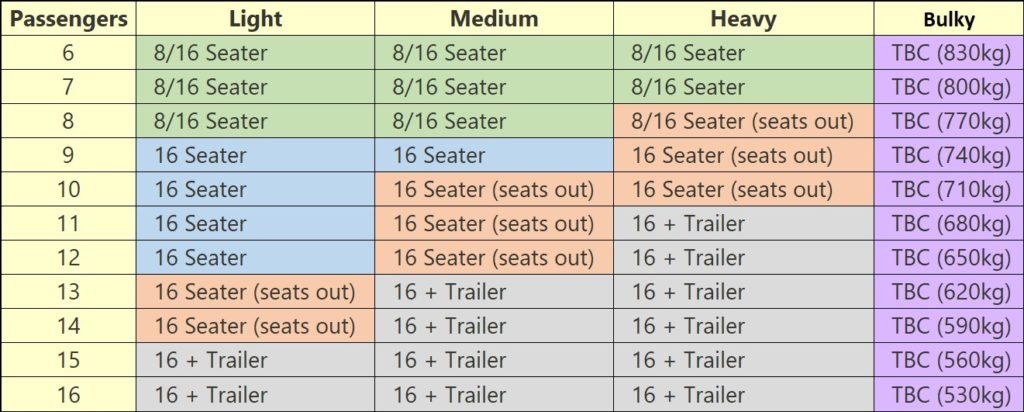
When taking bookings, we ask customers to tell us how much luggage they will have. This is never an exact science, but we have implemented the following definitions to make the process as simple as possible.
We calculate the estimated weight of the luggage, based on the number of passengers and the options the customer selects. We include guidance on our website to help customers choose the correct option.
Light Up to 10kg per person (up to one cabin sized bag per person)
Medium Up to 20kg per person (up to one 20kg case between every two people, plus a cabin bag each)
Heavy Up to 30Kg per person (one 20kg suitcase and cabin bag per person, plus one or two other light items such as foldable prams allowable)
Bulky 30kg+ per person and/or large items such as Golf clubs, bikes or skis.
When calculating how much luggage space is required, we allocate 30kg of space to each empty seat, plus a further 120kg if the back two seats have been removed, or 30kg if they haven’t.
Bulky luggage will always be subject to a manual check. Customers will need to provide their exact baggage weight limit. A full bus with more than 530kg of luggage will require multiple vehicles.
The following table shows a summary of the vehicle required for each luggage configuration;